

Milk and honey is the oldest combination in body care, and most of the recipes for it online will spoil in your bathroom within a week.
The problem is that almost every version tells you to use fresh milk. Fresh milk is water and protein, and putting either into a jar of oil and sugar creates something that grows things.
There is a simple fix, and with it this becomes the best winter scrub on the site.
 Save
The fix: powdered milk
Powdered milk gives you everything the fresh version was for, with none of the water.
It contains the same lactic acid, the same milk proteins and the same fats, in a dry form that sits happily in an oil and sugar base for months. It dissolves against wet skin as you use it, which is when you actually want it active.
Two tablespoons per jar is plenty. More makes the scrub chalky rather than creamy.
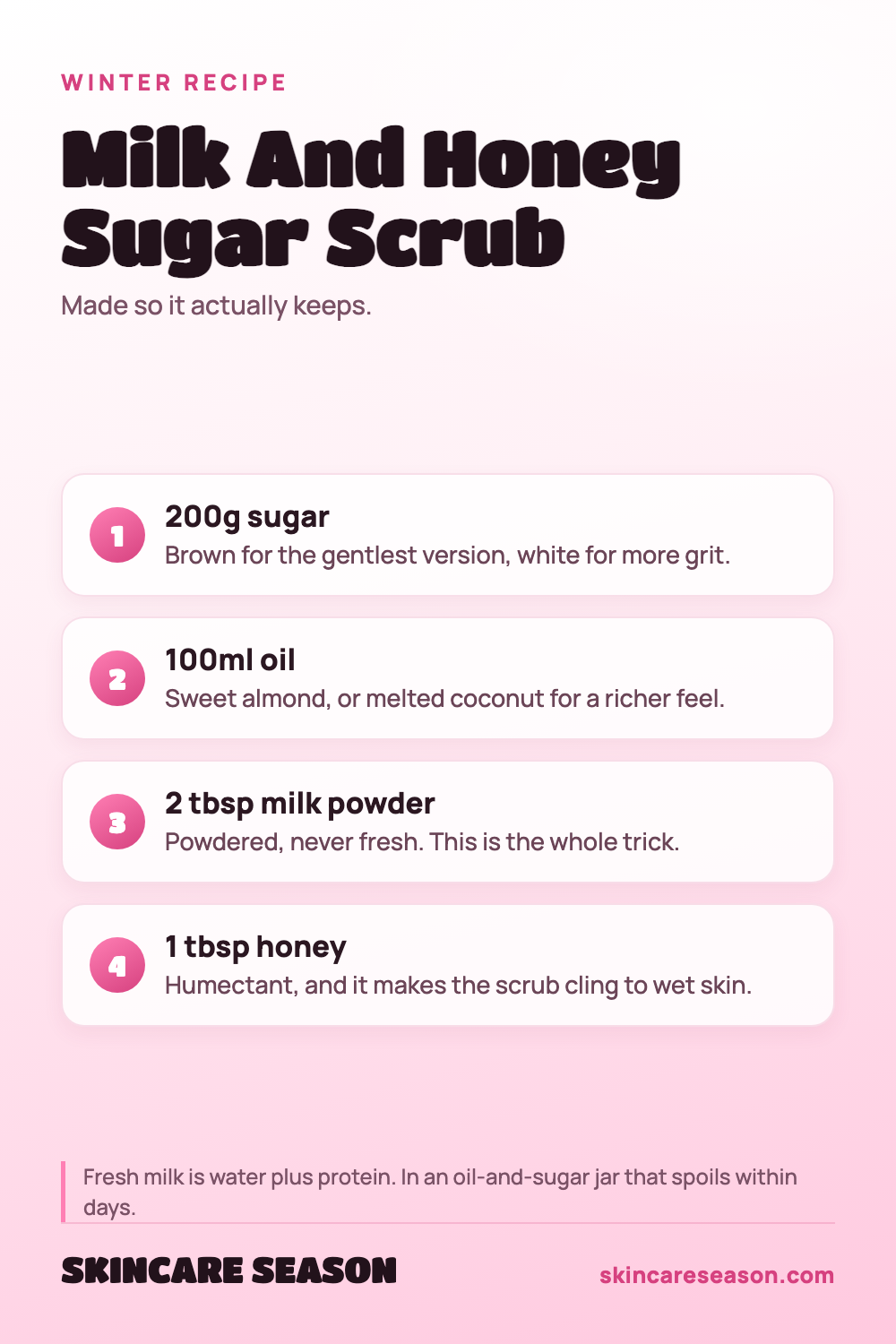
The recipe
 Save
Brown sugar is the better choice here, since this is a winter scrub aimed at dry skin and brown sugar is the gentlest grain. White works if brown is what you do not have.
 Save
What each part is doing
The sugar clears the flaky build-up that winter dryness produces. Nothing complicated.
The oil is doing the heavy lifting in January. Winter skin is short of oil more than it is short of exfoliation, and the oil film left behind is most of the benefit.
The honey is a humectant. It attracts water into the surface of your skin, and it also makes the scrub cling rather than sliding onto the shower floor.
The milk powder contributes lactic acid, which is a very mild chemical exfoliant, plus milk fats and proteins that soften. It is a small effect and it is real, and it is why this recipe has survived a few thousand years.
Why winter skin is different
The thing that dries you out in January is not the cold outside. It is the difference between the cold outside and the heated air inside, and the fact that heated indoor air holds almost no moisture.
Your skin loses water to that dry air constantly. Add hot showers, which strip oil, and you get the tight, flaky, itchy skin that arrives every year around the same time.
Which means the winter answer is more oil, not more scrubbing. IMO the most common January mistake is scrubbing harder at flakiness that is actually dehydration, and making the barrier worse in the process. :/
 Save
Making it
Break up any lumps in the brown sugar with a fork. Add the milk powder and stir the two dry ingredients together first, which stops the powder clumping when the oil goes in.
Add three quarters of the oil, fold gently, check the texture. Wet sand, as always. Add the rest a little at a time.
Honey last, folded through. Warm the jar of honey in a bowl of hot water for a minute first if it is stiff, since cold honey does not distribute properly.
Using it in winter
Once a week, not twice. Winter skin has less to give.
Lukewarm water rather than hot, which is genuinely hard in January and genuinely matters. Hot water strips oil faster than anything else you do.
And moisturise within three minutes, on damp skin, with something thicker than you would use in summer. A balm or a body butter rather than a lotion.
Watch this before you start
Storage, and the water rule again
Airtight jar, cupboard, dry spoon, two to three months.
The powdered milk does not change any of that, which is the entire reason to use it. A version made with fresh milk would need refrigerating and would still be questionable within about five days.
If you do want to make a fresh-milk version for a single use, mix a tablespoon in your palm right before you get in the shower and use all of it. That is fine. What is not fine is a jar of it sitting in a warm bathroom.
 Save
A note on the lactic acid
Milk contains lactic acid, and lactic acid is a genuine alpha hydroxy acid used in proper skincare at 5 to 10%.
The amount in powdered milk in a rinse-off scrub is far below that. So this is a very mild effect, not a chemical exfoliant, and anyone describing a milk scrub as a natural AHA peel is stretching considerably.
What it does contribute is softening, and combined with the honey it makes the finished scrub feel noticeably creamier than a plain sugar and oil version.
Where else the milk powder trick works
Once you know that powdered dairy solves the water problem, it opens up a few other recipes that are usually made badly.
A milk bath is the obvious one. Powdered milk plus Epsom salt in a jar, a scoop under running water, and it keeps indefinitely where a fresh-milk version would not survive the afternoon.
Powdered coconut milk works the same way and suits anyone avoiding dairy. Powdered oat milk is the gentlest of the three and the best choice for reactive skin.
The principle is the same every time. If a recipe calls for something wet, look for the dry version of it before you decide the recipe cannot be stored.
Common questions
Can I use fresh milk?
Only if you make it in your hand and use it immediately. Never in a jar you plan to keep.
What kind of milk powder?
Whole milk powder for the richest result. Skimmed works and is slightly less softening.
Can I use oat or coconut milk powder?
Yes. You lose the lactic acid but keep the creamy texture, and oat powder is genuinely soothing.
How often in winter?
Once a week. Skin is already under pressure from heating and hot water.
Why has mine gone gritty and chalky?
Too much milk powder. Two tablespoons per jar is the ceiling.
Is this suitable for the face?
No. Sugar grains are too sharp for facial skin regardless of what else is in the jar.
The short version
Brown sugar, oil, two tablespoons of powdered milk and a spoon of honey. Powdered, never fresh, because water is what ruins it.
Once a week, lukewarm water, and something thick on top within three minutes. 🙂


Leave a Reply