
Every other article on this site tells you not to scrub your face. This one is going to give you a recipe anyway, because plenty of people are going to do it regardless and the version below is genuinely the least harmful way.
But the honest advice comes first, because it would be dishonest to bury it under a recipe.
 Save
Why facial skin is different
The skin on your face is dramatically thinner than the skin on your arms and legs, and the outer layer that does the protecting is thinner still.
That layer is what a scrub abrades. On a heel, where the skin is many times thicker, a coarse grain removes build-up and reaches nothing important. On a cheek, the same grain reaches past the dead cells and into skin that was doing a job.
The damage is not visible immediately, which is the problem. Micro-tears do not show up in a mirror. What shows up is skin that stings a fortnight later, goes red for no reason, and reacts to a moisturiser you have used for years.
The honest recommendation
A chemical exfoliant does the same job better and without the abrasion.
Lactic acid at 5% is the gentle starting point for sensitive skin. Polyhydroxy acids like gluconolactone are gentler still, with molecules too large to penetrate quickly, which is exactly what you want on reactive skin.
Both dissolve the bonds holding dead cells on, rather than physically scraping them off. Twice a week, at night, and the result is smoother than any scrub gets you.
If you take one thing from this article, take that. The recipe below exists for people who have read it and want to scrub anyway. :/
 Save
If you are going to do it anyway
 Save
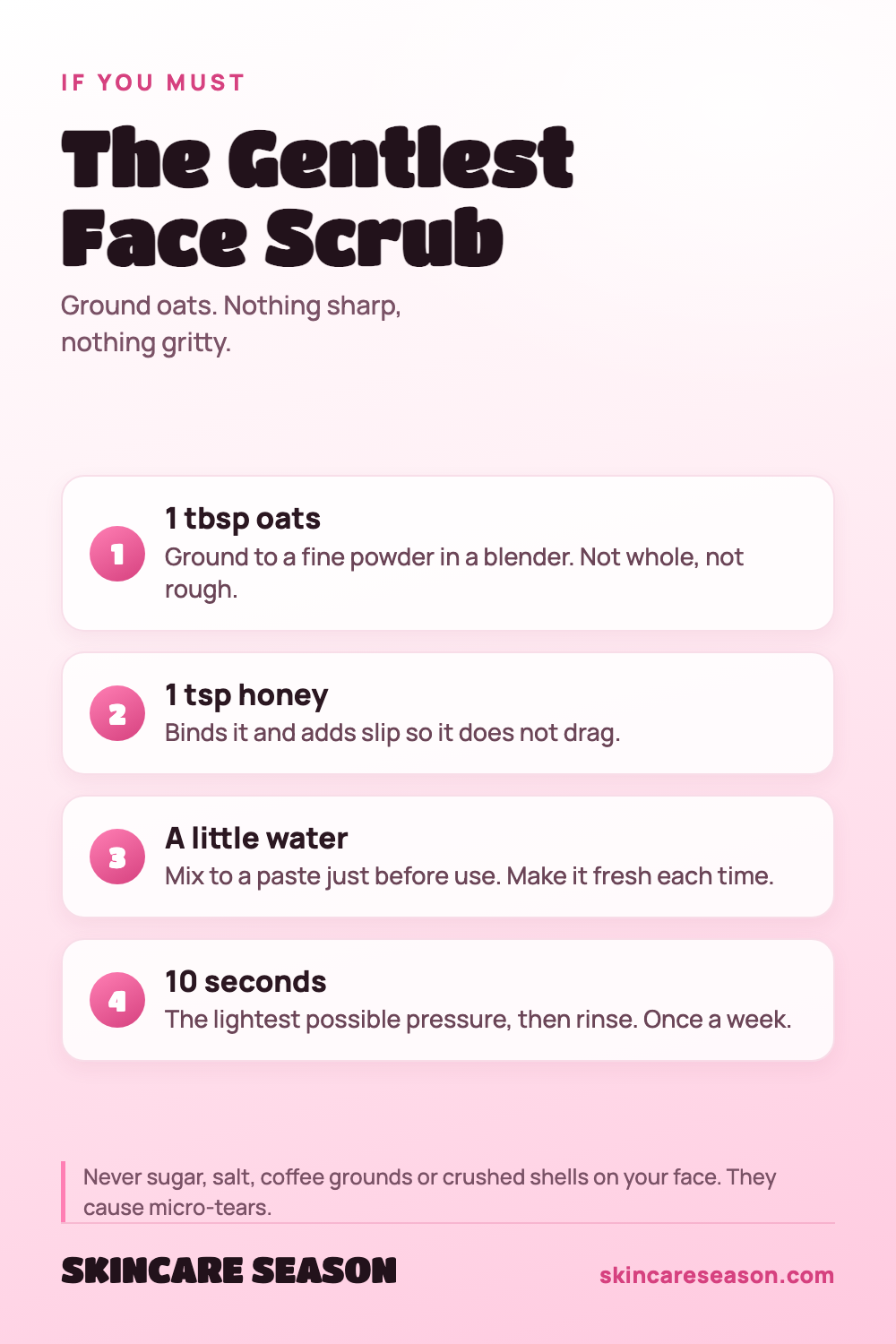
Ground oats are the only home exfoliant genuinely soft enough for facial skin. Not whole oats, not roughly chopped oats. Ground in a blender until it looks like flour.
Why oats specifically
Two reasons, and one of them is not about the scrubbing at all.
The physical reason is that oat particles are soft and irregular rather than crystalline. They break down under pressure instead of holding a cutting edge, which is the opposite of sugar and salt.
The second reason is that oats contain avenanthramides, compounds with genuine anti-inflammatory activity. This is why colloidal oatmeal appears in products aimed at itchy, irritated skin, and it is one of the few kitchen ingredients with real evidence behind it.
So an oat paste is simultaneously the mildest possible physical exfoliant and a mild soother. That combination is unusual.
Making it
Grind a few tablespoons of rolled oats in a blender or coffee grinder until you have a fine powder with no visible flakes. Store the powder dry in a jar.
To use, put a tablespoon of the powder in your palm, add a teaspoon of honey and a splash of water, and mix to a loose paste.
Make it fresh every time. This contains water, so it cannot be stored. A jar of pre-mixed oat paste is a bacteria culture within days. The dry powder keeps indefinitely, the paste does not keep at all.
 Save
Using it without doing damage
- On damp skin, after cleansing.
- Ten seconds. Not a minute. Ten seconds, in the lightest circles you can manage.
- No pressure at all. Let the paste move across the skin rather than pressing it in.
- Avoid the eye area entirely.
- Rinse with lukewarm water, pat dry, moisturise.
- Once a week maximum.
If your face is pink afterwards, you pressed too hard or went on too long. Pink is not a sign it worked.
What never to put on your face
This list matters more than the recipe.
Sugar. Crystalline and sharp-edged, regardless of how fine it is.
Salt. Sharper still, and it stings on any broken skin.
Coffee grounds. Far too coarse, however good they are on your legs.
Crushed nut shells or fruit stones. Jagged under magnification and the subject of a well-known lawsuit.
Baking soda. Not abrasive so much as alkaline. It disrupts your skin’s natural pH and strips the barrier, and it turns up in far too many homemade recipes.
Lemon juice. Acidic in an uncontrolled way and increases sun sensitivity. Not a DIY glycolic acid.
Watch this before you start
Signs you have over-exfoliated your face
Skin that looks slightly shiny and unusually smooth, which reads as a win. Then stinging when you apply things, tightness that moisturiser does not fix, and redness that is still there in the morning.
If that is you, stop all exfoliation for two weeks. Cleanser, a ceramide moisturiser, sunscreen, nothing else. It recovers.
 Save
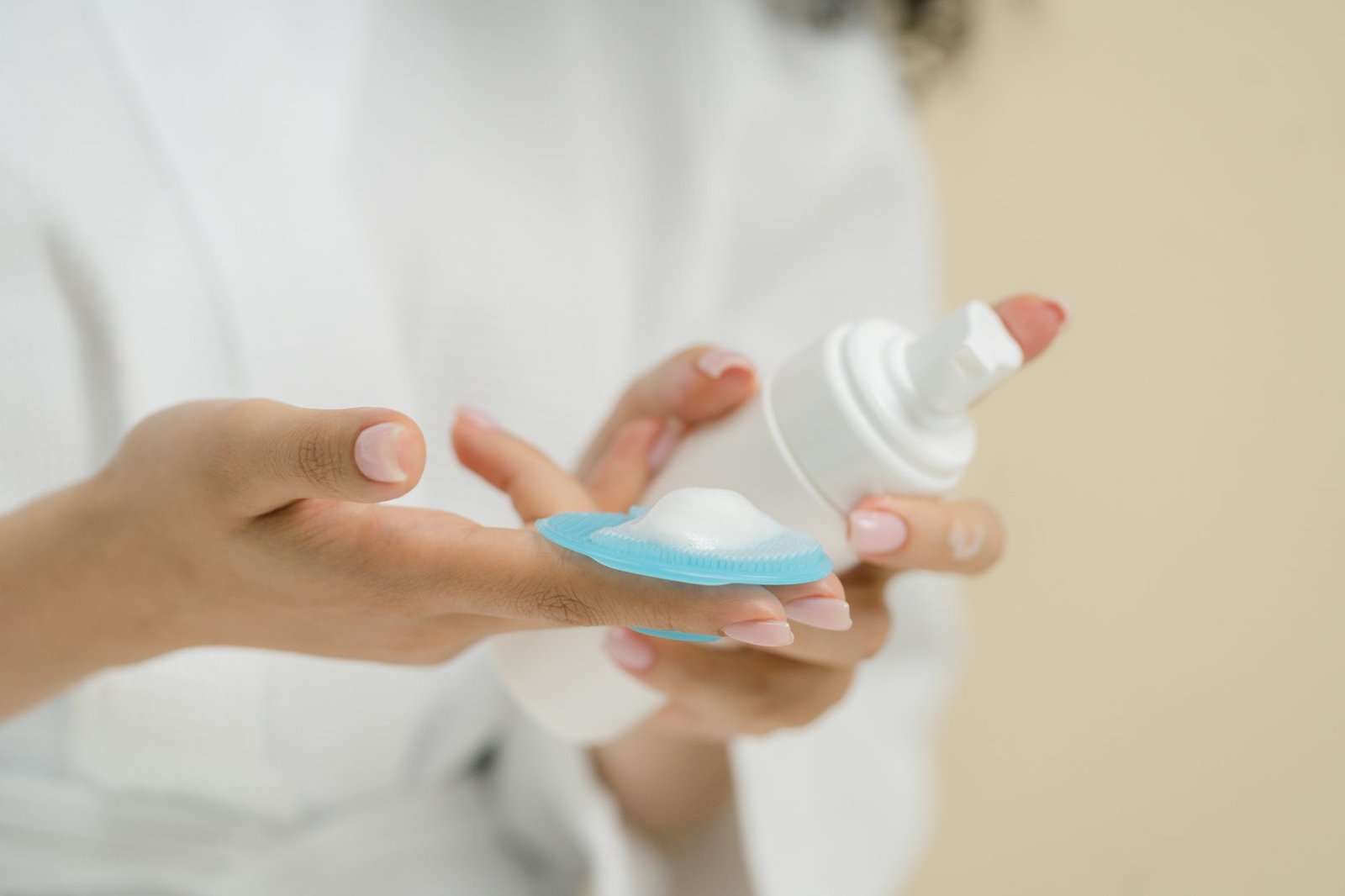
What about cleansing brushes and mitts
The same logic that applies to a scrub applies to anything else that physically abrades your face, and cleansing brushes get a pass they have not earned.
A brush used twice a day is physical exfoliation twice a day. That is far more than any dermatologist would recommend, and it is why a lot of people who bought one found their skin got worse after the first enthusiastic month.
If you own one, treat it as exfoliation rather than as cleansing. Once a week, on the softest setting, and not in the same week you are doing anything else abrasive.
Muslin cloths and flannels sit in the same category, milder but not neutral. Anything that removes cells by rubbing counts toward your weekly total.
Common questions
Is a homemade face scrub safe?
Ground oats with honey, used gently once a week, is about as safe as a physical facial exfoliant gets. Sugar, salt and coffee are not.
Can I store the paste?
No. Store the dry ground oats and mix a fresh batch each time.
How often can I use it?
Once a week at most, and less if your skin is at all reactive.
Is a chemical exfoliant really better?
Yes, for facial skin. It removes the same dead layer without the physical abrasion, and the results are more even.
Can I add sugar to make it work better?
No. That undoes the entire reason this recipe is safe.
What about a cleansing brush?
Same problem as a scrub, applied daily. If you use one, treat it as exfoliation and use it weekly rather than twice a day.
The short version
Ground oats and honey, mixed fresh, ten seconds of the lightest possible pressure, once a week. Nothing sharp, nothing gritty, nothing stored.
And if you can be persuaded, use a lactic acid or PHA product instead. It does the job better and it does not carry the risk. 🙂


Leave a Reply