

A whipped scrub is the one that looks like buttercream frosting in the jar, feels like mousse, and costs twenty pounds in a shop. It is also the one people most often try to make and end up with grainy soup.
The ingredients are not the difficult part. The order you combine them in is the entire recipe.
 Save
What makes it whipped
A normal scrub is grain suspended in liquid oil. A whipped scrub is grain folded into a solid oil that has had air beaten into it.
That air is the whole thing. Whipping a solid fat forces tiny air bubbles into it, which is exactly what happens when you whip butter for a cake, and it turns something dense into something light.
Which means you cannot make this with a liquid oil. Almond, olive and sunflower oil will not hold air. You need something solid at room temperature.
The method, which is the recipe
 Save
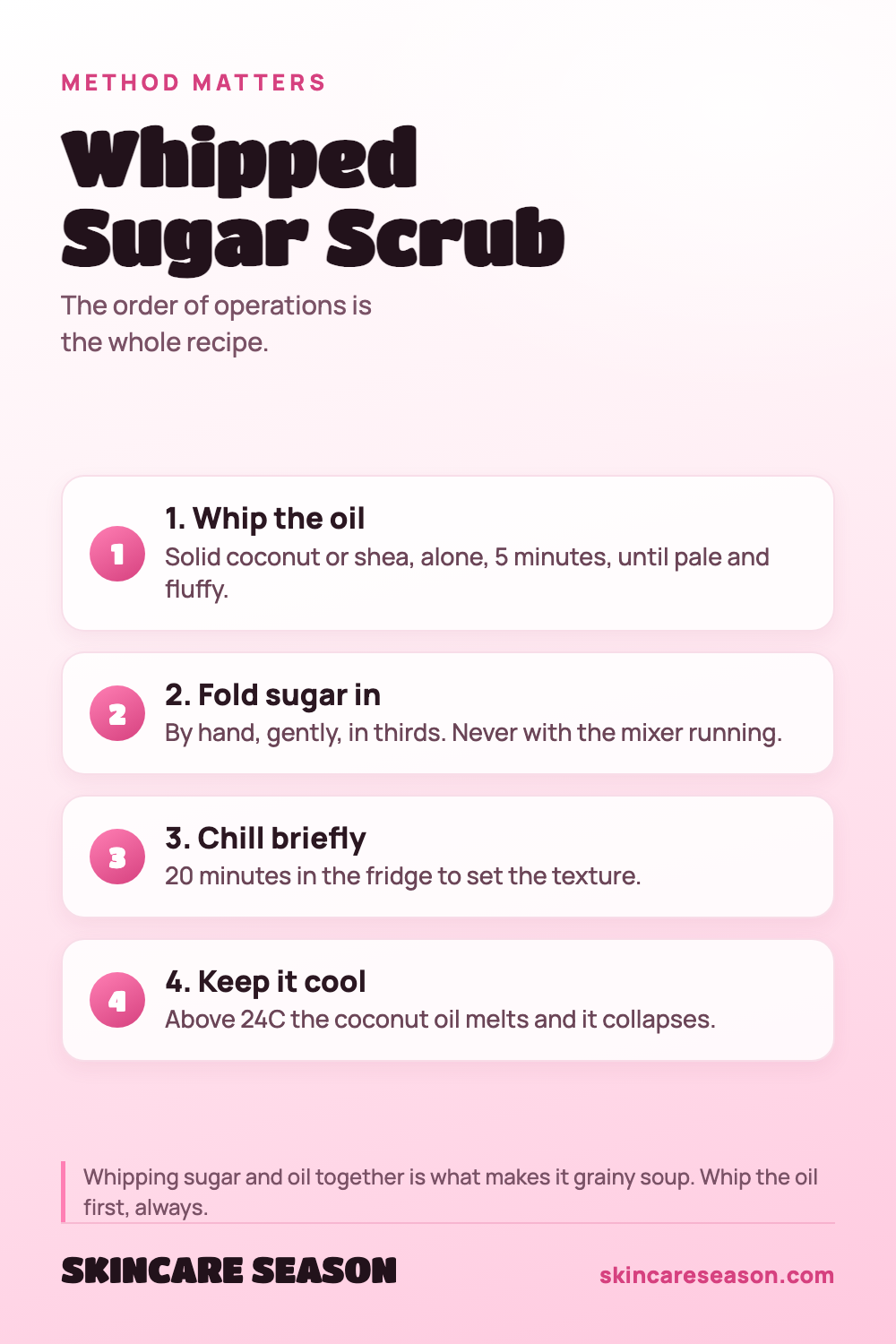
Step one is where every failed attempt goes wrong. If you put the sugar in and then whip, the beaters shatter the grains, the sugar starts dissolving into the oil, and you get a dense grainy paste that will never become fluffy.
 Save
Choosing the oil
Coconut oil is the easiest and the most temperamental. It whips beautifully and it melts at about 24 degrees, which is a normal room temperature in summer. Expect a summer batch to collapse.
Shea butter is more stable and stays whipped at higher temperatures. It has a distinct nutty smell that not everyone likes, and it can feel slightly grainy if it has been melted and cooled badly.
A mix of both is the best answer. Roughly two parts shea to one part coconut gives you the stability of shea with the lighter texture of coconut.
Mango butter is the underrated option. Firmer than shea, almost no smell, and it whips well.
Doing it properly
Put your solid oil in a bowl. It should be soft but not melted, roughly the texture of butter left out of the fridge for an hour. If it is fully liquid, chill it until it starts to set.
Whip with an electric mixer for a full five minutes. It will go from yellowish and dense to pale, glossy and about twice the volume. Five minutes feels like a long time and it is the correct amount.
Now put the mixer down. Add the sugar in three additions, folding by hand with a spatula each time. Gently, turning the mixture over rather than stirring through it.
Then twenty minutes in the fridge to firm up, and into a jar.
 Save
The ratio is different
A normal scrub is two parts sugar to one part oil. A whipped scrub is closer to one to one, sometimes even more oil than sugar.
That is because the oil is doing structural work here rather than just binding. Too much sugar and the weight collapses the air you spent five minutes beating in.
Start at one to one, and if it feels insufficiently scrubby, go to one and a quarter parts sugar. Do not go to two.
Why yours collapsed
Four causes, in order of how common they are.
- You whipped the sugar in. By far the most common. Whip oil alone, fold sugar by hand.
- The oil was fully melted. Liquid oil cannot hold air. Chill it to a soft-solid first.
- Too much sugar. The weight crushes the structure.
- A warm bathroom. Coconut oil melts at 24 degrees and there is no fixing that except a cooler cupboard.
If it does collapse, it is not ruined. It is now a normal scrub and works perfectly well. IMO that is worth knowing before you throw a bowl of it away in frustration. 🙂
Watch this before you start
Storage, and the temperature problem
This is the least stable scrub on the site and it wants a cool, dark cupboard well away from the bathroom.
In summer, or if your home runs warm, a whipped coconut oil scrub will melt and reset into a hard, dense block. It still works, it just is not whipped any more, and once it has melted you cannot re-whip it back to the same texture.
Shea-based versions survive warmth considerably better, which is the main argument for using them.
Two to three months either way, in an airtight jar, used with a dry spoon.
 Save
Using it
It is much richer than a normal scrub, so you need noticeably less. A teaspoon-sized scoop covers a whole leg.
On damp skin in the shower, light circles, thirty seconds. It leaves a heavier oil film than a standard scrub, which is lovely in winter and can feel like too much in July.
Rinse in warm water. You may not need a moisturiser afterwards with this one, which is unusual and is because of the ratio.
Once a week. The oil content makes it feel gentle, and the sugar in it is doing exactly the same thing as in any other scrub.
Common questions
Why is my whipped scrub grainy?
You whipped the sugar rather than folding it in, or the shea butter was melted and cooled too quickly.
Can I use olive or almond oil?
Not on their own. They stay liquid and cannot hold air. Use a solid butter as the base and add a splash of liquid oil at most.
Why did it melt?
Coconut oil melts at about 24 degrees. Use shea, or keep it somewhere cool.
Can I re-whip it after it melts?
Not to the same texture. Chill it solid and whip again and you will get something denser but usable.
How much sugar?
Roughly equal to the oil by volume. Considerably less than a standard scrub.
Do I need a moisturiser after?
Often not. The oil ratio is high enough that it moisturises as it goes.
The short version
Whip the solid oil alone for five minutes until pale and doubled. Fold the sugar in by hand, in thirds, roughly one to one. Chill for twenty minutes. Keep it somewhere cool.
Whipping the sugar in is the mistake, and it is the only one that really matters. 🙂


Leave a Reply