
The Ordinary’s entire pitch is that they tell you exactly what is in the bottle. Which is true, and also completely useless if you do not already know what those words mean.
They sell several different retinol products with near-identical packaging and numbers that look like a ranking. They are not a ranking. They are different products for different people.
Here is which one you should be holding.
The two families
Everything they sell splits into two groups, and this is the part the labels never explain.
Granactive Retinoid is a different molecule to retinol. It is designed to be gentler, works through a slightly different route, and causes noticeably less irritation. It is the beginner option.
Retinol in Squalane is plain retinol suspended in an oil. Stronger, more traditional, more likely to irritate, and the squalane is there to cushion it.
If you take nothing else from this: Granactive is the gentle family, Retinol in Squalane is the assertive one.
Why the numbers mislead everyone
You cannot compare 2% Granactive to 0.5% Retinol. They are different molecules, so the percentages are measuring different things.
2% Granactive is gentler than 0.2% Retinol despite the bigger number. Which is genuinely terrible labelling, and the single most common way people end up with a peeling face. :/
Watch this before you start
So which one do you buy
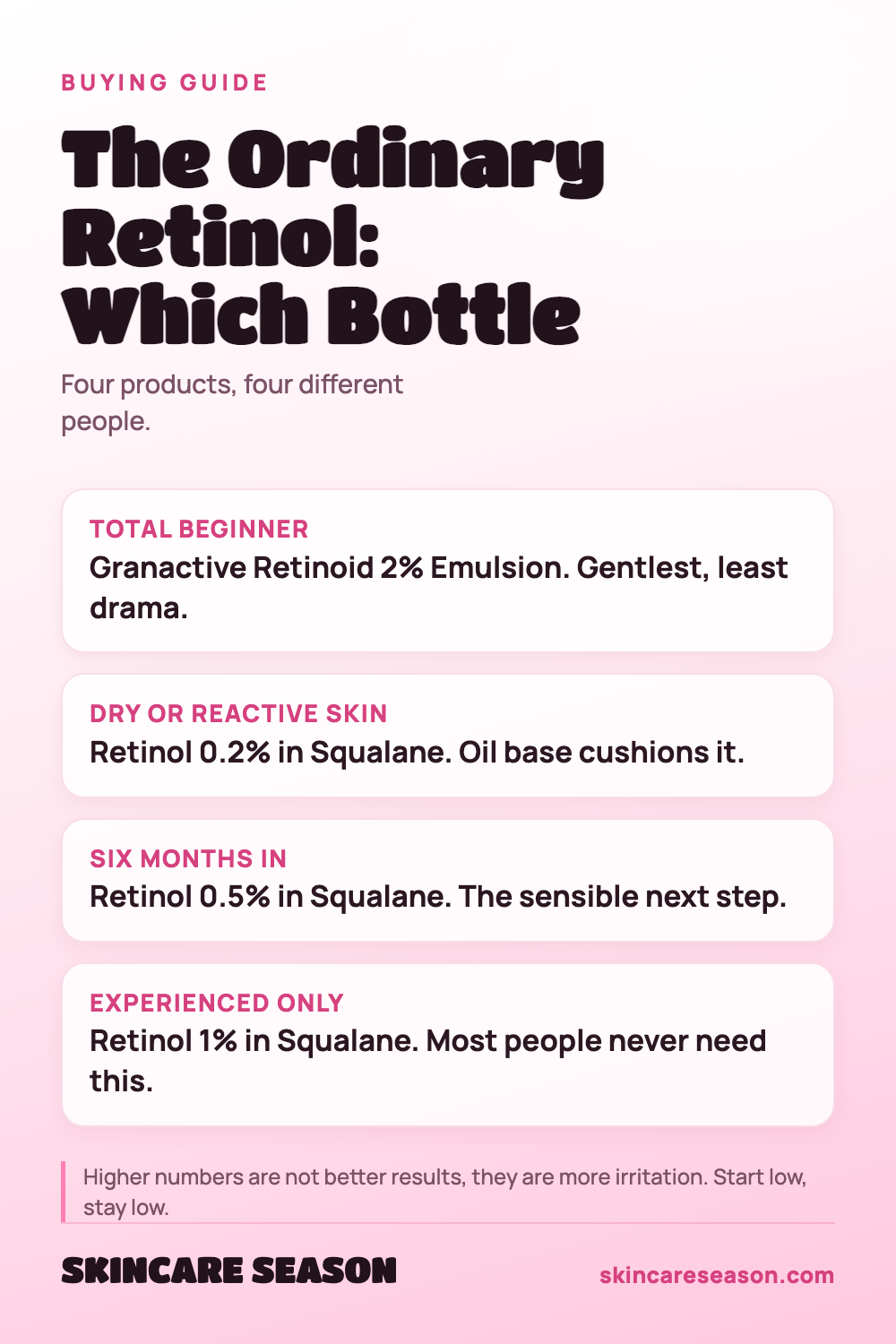
The honest answer for most people reading this is the first row. Start with the emulsion, spend three months there, and only move if you are completely comfortable.
Granactive Retinoid 2% Emulsion
The one to buy if you have never used a retinoid. Light, lotion-like, absorbs quickly, and the least likely of the lot to cause a problem.
It is also the one most likely to make people say “this is not doing anything”, because gentle and slow is exactly the point. Give it twelve weeks before you judge it.
Retinol 0.2% in Squalane
The entry point for the oil-based family. It feels like a facial oil, which suits dry skin and annoys oily skin.
Good choice if your skin is dry but not especially reactive, or if you have used retinoids before and are restarting after a break.
Retinol 0.5% and 1% in Squalane
0.5% is the sensible step up after six uneventful months at 0.2%. It is meaningfully stronger and you should expect a fortnight of adjustment.
1% is where people hurt themselves. It is not a beginner product, it is not a shortcut, and the number of people who genuinely need it is small. FYI if you are buying it because the lower ones “did nothing” after three weeks, three weeks was the problem, not the strength.
How to use any of them
- Night only. All of them. No exceptions.
- Dry skin, after cleansing, before moisturiser.
- Pea-sized for the entire face.
- Once a week to begin, building up over two months.
- Sunscreen every morning, which is not optional.
Do not use them alongside exfoliating acids on the same night, and do not layer two of them thinking it doubles the effect.
What the squalane is actually for
Squalane is an emollient. It sits on the surface, slows water loss, and gives the retinol something to disperse into.
That matters because the most common retinol complaint is dryness, and suspending it in an oil takes the edge off before it starts. It is also why those versions feel greasy: you are putting an oil on your face, because that is what it is.
On dry skin this is a feature. On oily or congested skin it is a nuisance, and the emulsion is the better texture even setting the strength question aside.
Price, and what that gets you
All of these sit in single figures, which is the reason the brand exists and the reason this shelf is so busy.
What you are paying for is one active in a simple base. What you are not paying for is a formula designed to feel nice, which is why the textures are divisive and why pilling comes up so often.
IMO that is a fair trade at this price, but it does mean the cheapest bottle is not automatically the best value. A product you abandon in week two because it pills under your sunscreen cost you everything you spent on it.
A realistic first three months
Weeks one to four you are looking for nothing to happen. No flaking, no tightness, no stinging. That is success at this stage.
Weeks four to eight, texture starts to smooth and your skin takes makeup better. Weeks eight to twelve is when other people notice before you do.
If you are still completely comfortable at twelve weeks, that is the moment to consider stepping up. Not before, and not because a bigger number was in stock.
Common questions
Can I use two of these together?
No. Pick one. Layering retinoids multiplies irritation, not results.
Is the squalane version greasy?
It is an oil, so yes, somewhat. On oily skin the emulsion is a better texture match.
Which is closest to a prescription retinoid?
None of them. Prescription strength is a different category and a different conversation, with a doctor.
How long before I move up?
Six months at your current step, with zero irritation, and only if you want to. Plenty of people stay on the emulsion forever quite happily.
Why did my skin get worse at first?
Either you started too strong or too often. Drop back a step, use it once a week, and rebuild slowly.
Do I need their moisturiser too?
No. Use whatever moisturiser you already get on with. Sticking to one brand across a routine is a marketing idea rather than a skincare one.
Can I use it on my neck and chest?
Yes, and it is worth doing, but that skin is thinner and reacts sooner. Start at half the frequency you use on your face.
What if it pills under my moisturiser?
Less product, and wait a full two minutes before layering. The squalane versions pill more readily than the emulsion.
The short version
New to this? Granactive Retinoid 2% Emulsion. Dry skin and some experience? Retinol 0.2% in Squalane. Everything else is for later, or never.
The number on the front is not a score. Buying the biggest one is the most common and most expensive mistake on that shelf.