
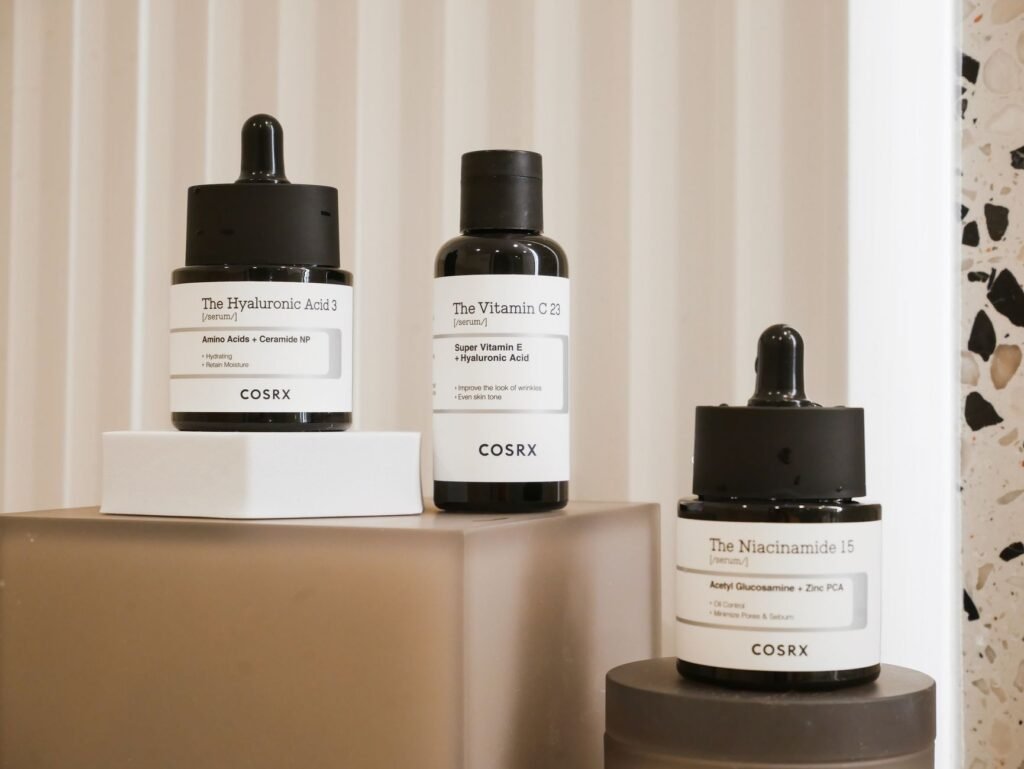
Niacinamide is the most bought and least understood thing on the shelf. It is in everything, it is cheap, and almost nobody can tell you what it actually did for them.
Part of that is because the changes are gradual and you look at your own face every single day. The other part is that the marketing promises a transformation and what you get is closer to a slow tidy-up.
So here is the honest version, week by week, of what eight weeks of niacinamide looks like.

What niacinamide actually does
Niacinamide is a form of vitamin B3, and unusually for skincare it does several unrelated things reasonably well rather than one thing brilliantly.
It helps your skin make more ceramides, which is the mortar between your skin cells, so your barrier holds water better. It calms inflammation, which is why redness settles. It regulates sebum, so oily skin gets less shiny. And it interferes with pigment being handed to your surface cells, which is the dark mark part.
None of those are fast. They are all cumulative, which is exactly why people give up.
Why nobody notices it working
Because it is a tidy-up rather than a transformation. If you have a specific complaint like one dark mark, you will stare at that mark and conclude nothing happened.
Meanwhile your skin is slightly less oily, slightly less red, and holding moisture better, and you will not clock any of it because it happened at a rate slower than you can perceive. IMO this is the single most under-appreciated thing about the ingredient.
Watch this before you start
The eight week timeline, honestly
Here is what to expect, assuming a 5% serum used once or twice a day on clean skin.
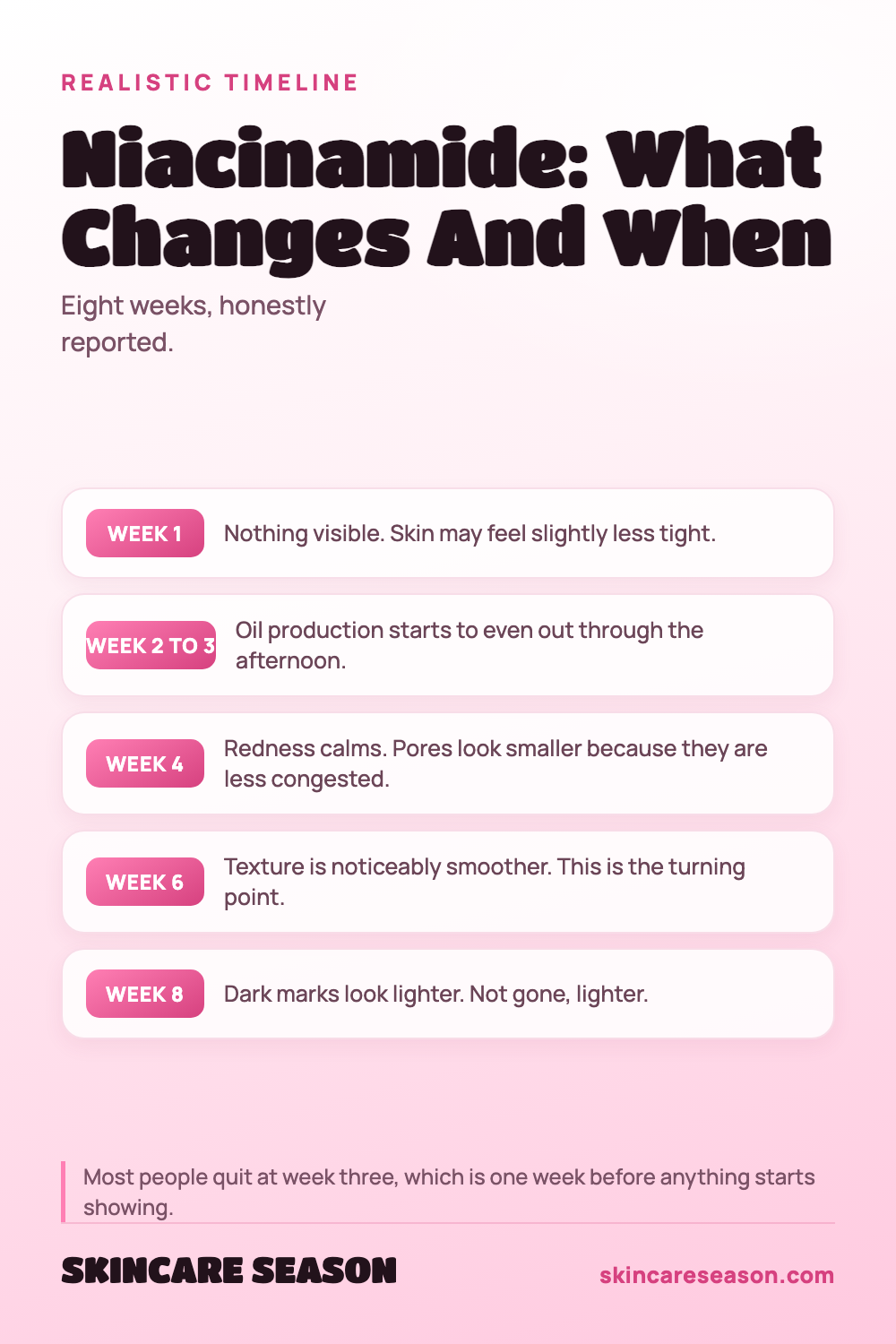
Note where the turning point is. Week six. If you stop at week three because “it is not doing anything”, you stopped one week before it started.

What strength to buy
5% is the number. It is where most of the research sits and where the results-to-irritation ratio is best.
- 2% to 4% is fine and gentle, common in moisturisers rather than serums.
- 5% is the sweet spot and what you should buy.
- 10% is not twice as good. For a lot of people it causes flushing and irritation, and irritated skin makes redness worse, which is the opposite of why you bought it.
The famous 10% plus zinc formula is enormously popular and is genuinely too strong for plenty of people. If your skin is at all reactive, start at 5%. :/
How to take a before photo that is actually useful
This matters more than the product. You cannot judge gradual change on your own face from memory.
- Same light. Daylight, by a window, never a bathroom bulb.
- Same angle. Straight on, and one of each side.
- No makeup, no filter, and do not smile in one and not the other.
- Same time of day. Skin at 8am and 8pm are different skins.
Take one on day one, then week four, then week eight. FYI the week four photo is usually the one that convinces people to keep going.
What to pair it with
Niacinamide is famously easy going. It sits happily with almost everything.
It works well alongside hyaluronic acid, and it pairs nicely with zinc for oily skin. It is fine before moisturiser and fine under sunscreen.
The old warning about not mixing it with vitamin C comes from lab conditions that do not really apply to finished formulas. If you want to be careful, use vitamin C in the morning and niacinamide at night, and stop worrying about it.
What it will not do
It will not clear active breakouts on its own. It will not remove deep pigmentation. It will not shrink the physical size of your pores, because pore size is largely genetic. What it does is make pores less congested so they look smaller, which is a different sentence.
And it will not do anything at all for fine lines in eight weeks. That is a different ingredient and a much longer timescale.

How to actually use it
Niacinamide goes on after cleansing and after any watery toner, but before anything thick. It is a thin serum, so it belongs near the start of the routine.
Two or three drops for the whole face. More is genuinely wasted, because absorption plateaus and the extra just sits there costing you money.
Give it thirty seconds to sink in before moisturiser. If you are using it morning and night, that is fine, and it is one of the few actives where twice a day causes nobody any trouble.
- Morning: cleanse, niacinamide, moisturiser, sunscreen.
- Night: cleanse, niacinamide, moisturiser. Add retinol between the niacinamide and the moisturiser if you use it.
Who gets the most out of it
Oily and combination skin see the clearest results, because the sebum regulation is the fastest-acting of its effects and the most visible in a mirror.
Skin that gets red easily is the second group. The anti-inflammatory effect is real and it shows up around week four, which is early by skincare standards.
If your main complaint is dryness, niacinamide helps via the ceramide route but a proper moisturiser will do more, faster, for less. And if your only concern is fine lines, this is not the ingredient you were looking for.
Common questions
Morning or night?
Either, and both is fine. If you are using one product, morning suits oily skin better because the oil control shows through the day.
How long until I see anything?
Four weeks for the first honest signs, eight weeks for the change worth photographing. Anything faster is your skin having a good day.
Can I use it with retinol?
Yes, and it is a good pairing. Niacinamide helps with the barrier disruption retinol causes. Apply niacinamide first, then retinol, then moisturiser.
Is 10% better than 5%?
No. It is stronger, which is not the same thing. More people get flushing at 10% and irritation undoes the benefit.
Why is my skin worse in week one?
Usually the rest of the formula rather than the niacinamide itself, or too high a percentage. Drop to 5% and give it a fortnight.
The short version
Buy 5%. Use it once or twice a day. Take a photo on day one in daylight. Do not judge it before week six.
It is not a dramatic ingredient and it was never going to be. It is the one that quietly makes everything else you do work slightly better. 🙂