


Most combination skin routines you find online have nine steps and assume you have twenty minutes and a shelf of products. Almost nobody keeps that up past a fortnight.
This one is four minutes total across the whole day, uses five products, and is designed to be kept rather than admired.
 Save
The whole routine
 Save
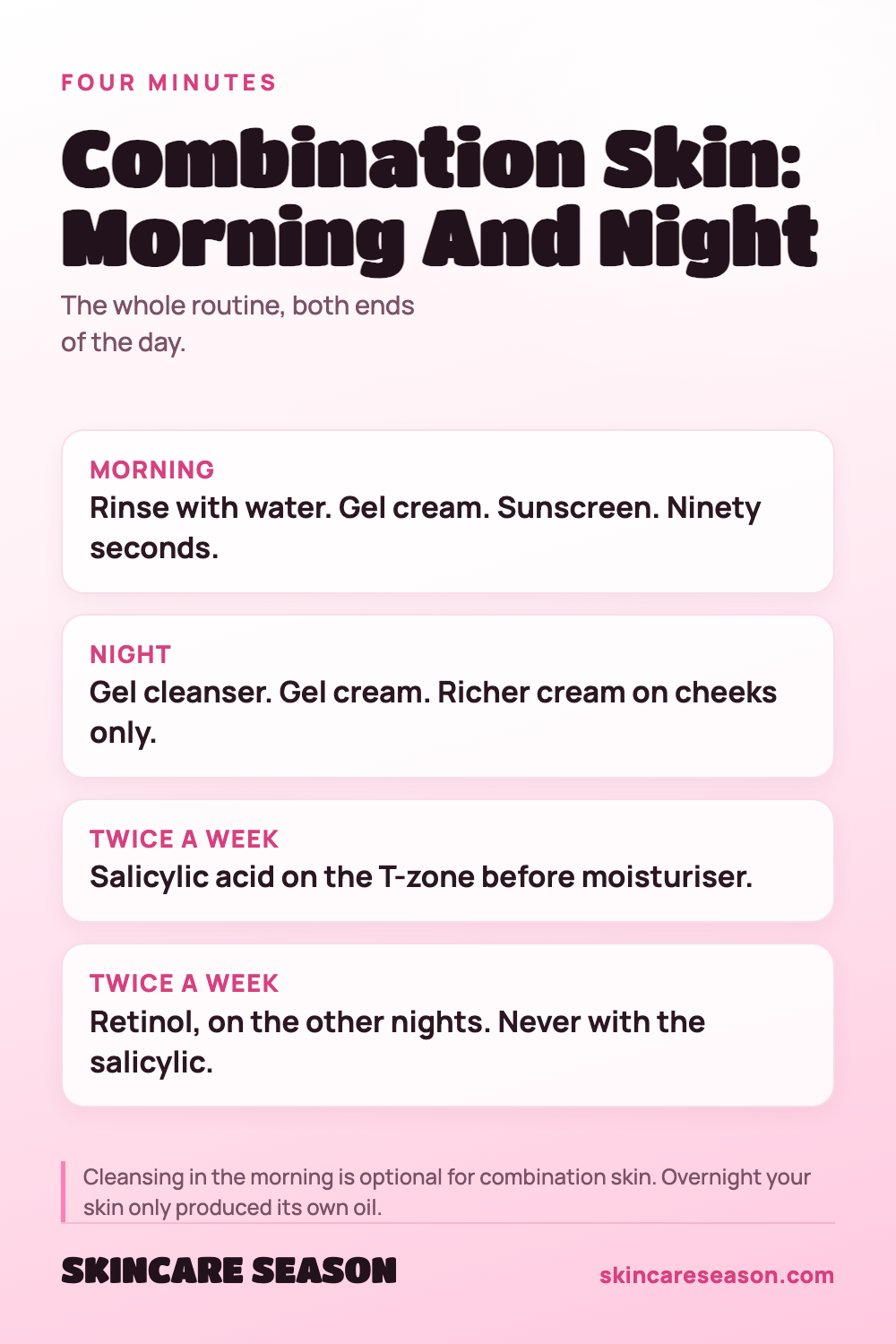
Ninety seconds in the morning, two and a half at night. The actives appear twice a week each, on alternating nights, which is the part that keeps this simple.
Morning, ninety seconds
Rinse with lukewarm water. No cleanser. Overnight your skin produced its own oil and there is nothing on it worth removing. Skipping the morning cleanse is the easiest improvement most combination skin can make.
Gel cream, more on the cheeks. A pea-sized amount, spread with the majority going onto the cheeks and whatever is left brushed lightly over the T-zone.
Sunscreen. A fluid or gel texture, two fingers’ worth, everywhere. Wait a minute before makeup if you wear it.
That is the morning. If you are pushed for time, the sunscreen is the one that matters most.
 Save
Night, two and a half minutes
Gel cleanser. Lukewarm water, thirty seconds of massaging, rinse. If you wear makeup or a heavy sunscreen, an oil or micellar water first, then the gel cleanser.
Actives, twice a week each. Salicylic acid on the T-zone on two nights. Retinol on two other nights, everywhere. Never both on the same night.
Gel cream, again with more on the cheeks.
A richer cream or a couple of drops of oil on the cheeks only, if they still feel tight.
Why the water-only morning works
This is the change people resist most and benefit from most.
Cleansing strips oil. In the morning there is very little oil to strip, because you washed eight hours ago and have been asleep since. What you remove is mostly your own sebum, which your cheeks needed.
Combination skin then responds in the predictable way: dry cheeks get drier, and the T-zone produces more oil to replace what was taken. So the morning cleanse actively widens the gap between your two zones.
IMO if you try one thing from this article, try a fortnight of water-only mornings. 🙂
Watch this before you start
The alternating nights
Two actives, two nights each, never together. Something like Monday and Thursday for salicylic, Tuesday and Friday for retinol, and nothing on the other three nights.
The nights with nothing are not wasted. They are when your barrier rebuilds, and skipping them is how people with perfectly sensible routines end up over-exfoliated.
Both actives go on dry skin after cleansing and before moisturiser. Salicylic on the T-zone only. Retinol everywhere, avoiding the eye area.
 Save
Building up to it
Do not start with both actives. Start with the base routine only, for two weeks, and see where your skin actually is once it has settled.
Then add one active, once a week, for a fortnight. Then twice a week. Then the second active, the same way.
Getting to the full routine takes about two months if you do it properly. Trying to start there is the most common reason people conclude their skin is too sensitive for actives.
What is deliberately not in this routine
Toner. Most do nothing a moisturiser does not do better.
Essence. An extra hydrating layer. Nice if you enjoy it, unnecessary.
Eye cream. Usually a lighter moisturiser at a higher price. Your gel cream can go there.
Face masks. Occasional treats. A clay mask on the T-zone once a week is fine if you like them.
Double cleansing in the morning. No.
None of those are harmful. They are just not doing enough to earn a place in a routine you have to repeat every day for years.
 Save
When to change it
Twice a year, roughly. In summer your cheeks may not need the extra layer at all. In winter they will need it every night, and you may want to drop the salicylic to once a week.
The rest stays the same. Combination skin shifts in degree rather than in kind, and rebuilding the whole routine seasonally is more effort than it repays.
What to do when it stops working
Routines drift out of suiting you, usually with the seasons or after a change in climate, medication or stress.
The instinct is to add something. The better first move is to subtract, take the routine back to cleanser, gel cream and sunscreen for two weeks, and see what your skin does with nothing being asked of it.
Most of the time that resolves it, and you reintroduce the actives one at a time. Occasionally it reveals that one product was the problem all along, which you would never have identified while using five.
If two weeks of the basics does not settle it, that is the point where a professional opinion is worth more than another purchase.
The one thing to get right first
If you take nothing else from this, take the sunscreen.
Every other step here is optimising. Sunscreen every morning is the one with the largest effect on how your skin looks in ten years, and it is the step people treat as optional because the payoff is invisible and slow.
A fluid or gel formula, two fingers’ worth, every morning, regardless of weather or season. That single habit outperforms the rest of this routine combined.
Common questions
Can I really skip cleansing in the morning?
Yes, and for combination skin it usually helps. Rinse with lukewarm water instead.
Can I use both actives on the same night?
No. Alternate nights, with rest nights between.
How long before this routine shows results?
Two weeks for comfort, six to eight for texture and congestion.
Do I need an eye cream?
No. Your moisturiser works there. Eye creams are mostly a marketing category.
What if my cheeks are still dry?
Add the richer layer at night, on the cheeks only, over the gel cream rather than instead of it.
Is four minutes really enough?
Yes. Routine length correlates with cost, not results. Consistency is what matters.
The short version
Morning: water, gel cream with more on the cheeks, sunscreen. Night: gel cleanser, gel cream, richer layer on cheeks if needed. Salicylic on the T-zone twice a week, retinol twice a week, never together.
Four minutes, five products, three rest nights. Build up to it over two months rather than starting at the end. 🙂


Leave a Reply