

Every retinol article assumes your skin can take it. If yours cannot, that advice is worse than useless, because the standard suggestion is to push through and the pushing is what does the damage.
Reactive skin can almost always use a retinoid. It just needs a different product, a slower schedule, and a much better moisturiser than most people bother with.
Here is what to actually look for.
What makes a retinol gentle
Three things, and only one of them is the percentage.
The first is the molecule. Retinol converts to retinoic acid in two steps. Gentler retinoids like the granactive types take a different route with less of the irritation, and they are the sensible starting point for reactive skin.
The second is delivery. Encapsulated retinol is wrapped so it releases over hours rather than all at once, which flattens the spike that causes the stinging.
The third is the base it sits in. A retinol in a rich cream behaves very differently to the same percentage in a thin, alcohol-heavy serum.
What to look for on the label
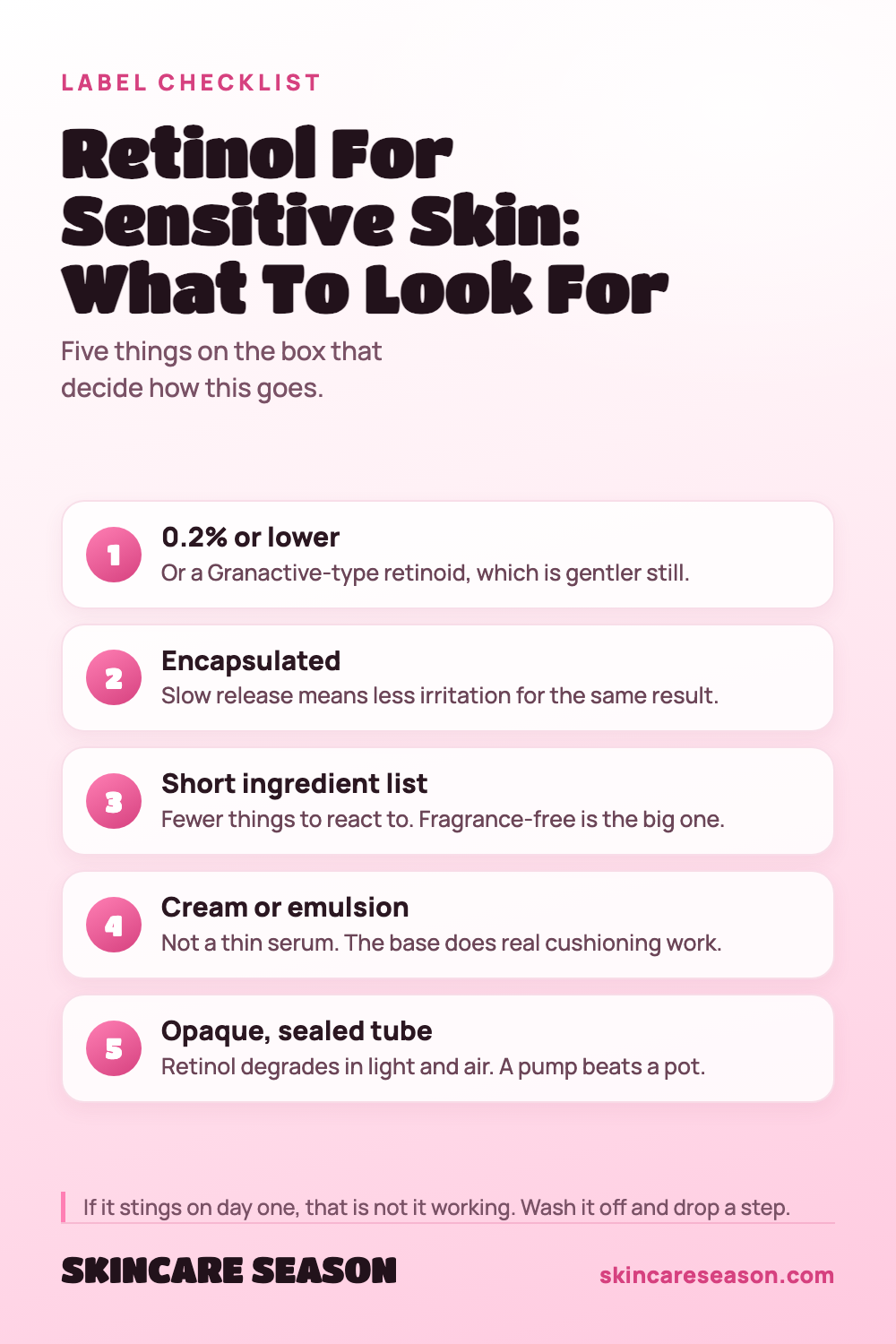
The fragrance point deserves emphasis. Fragrance is one of the most common causes of reactions, and a fragranced retinol gives you two things to blame and no way to tell them apart.
Watch this before you start
Formats, ranked for reactive skin
Encapsulated retinol in a cream base. The best combination there is. Slow release plus a cushioning base.
Granactive-type retinoid emulsion. Gentler molecule, light texture. Excellent starting point, especially if creams feel heavy on you.
Retinol in squalane or another oil. Good for dry reactive skin. The oil takes the edge off, though it is greasy and can pill.
Retinol in a thin water-based serum. Usually the harshest option for sensitive skin. Nothing cushions it and the other ingredients tend to be more active too.
The schedule matters more than the product
You can buy the gentlest retinol ever formulated and still wreck your face by using it every night in week one.
For reactive skin, halve the normal beginner schedule. Once every ten days for a month. Then once a week for a month. Then twice a week, and stay there for a long time.
That is slow enough to feel silly. It is also the version that works, because the alternative is three weeks on and six weeks recovering. :/
The buffering method
Moisturiser first, then retinol on top, then moisturiser again. This is the single most useful trick for skin that reacts.
It reduces how much active reaches the skin at once, which is exactly the trade you want when you are starting. Once you are comfortable at twice a week you can drop the first layer if you want to.

What to remove from your routine first
Before you add a retinoid, take things away. Reactive skin usually reacts because it is already dealing with too much.
- Exfoliating acids. Stop entirely for two weeks before you start.
- Physical scrubs. Stop permanently, honestly.
- Fragranced anything, especially cleansers and moisturisers.
- Alcohol-heavy toners, which strip the barrier you need intact.
- Vitamin C temporarily, until the retinoid is settled. Then reintroduce in the morning only.
Two weeks of a boring three-step routine before you add anything is not wasted time. It is how you find out what your skin is actually like when nothing is provoking it.
Signs you have gone too fast
Flaking around the nose and mouth. Skin that stings when you apply anything, including water. A tight feeling that does not go away after moisturiser. Redness that is still there the next morning.
Any of those means stop for a week, moisturise heavily, and restart one step lower. Not push through.

The moisturiser matters more than the retinol
This is the part people skip because moisturiser is boring and retinol is exciting. On reactive skin it is backwards: the moisturiser is doing the work that lets the retinol stay in your routine.
What you want is something with ceramides, or glycerin, or squalane, and ideally more than one of them. Ceramides rebuild the barrier the retinoid is disrupting, and glycerin holds water in the layers underneath.
Thicker is generally better here, and a pot you can see the texture of usually beats a thin lotion in a pump. Apply it while your skin is still slightly damp, which traps the water rather than sealing dry skin under a lid.
If you are choosing between spending money on a fancy retinol or a properly good moisturiser, buy the moisturiser. The cheap retinol in a good routine beats the expensive one in a bad one.
How to patch test properly
Almost nobody does this and it takes four days.
Put a small amount on the same spot, just in front of your ear or on your inner forearm, once a day for four days running. One application tells you nothing, because irritation from retinoids is cumulative rather than immediate.
If nothing happens by day four, it is reasonable to try it on your face. If something does happen, you learned that on a patch of skin nobody can see rather than across your whole face on a Sunday night.
Common questions
Is there a retinol that never irritates?
No. Some irritate far less, and gentle formats plus a slow schedule get most people through. But a product that provably does nothing to anyone would also do nothing for you.
What percentage should I start on?
0.2% or lower, or a granactive-type product where the percentage is not comparable. Never above 0.3% to begin.
How long before I know it suits me?
Six weeks with no reaction means you are tolerating it. Twelve weeks before you judge results.
Can I use it if my skin is already irritated?
No. Get back to baseline first. Adding an active to an upset barrier makes both problems worse.
Does a higher price mean gentler?
Not reliably. Encapsulation and a good base cost money, so there is some correlation, but plenty of expensive retinols are thin serums with fragrance in them.
The short version
Low percentage or a granactive-type retinoid, encapsulated if you can find it, in a cream base with no fragrance. Once every ten days to start. Buffer with moisturiser. Strip everything else out of your routine first.
Reactive skin is not a reason to skip retinoids. It is a reason to be slower than the box tells you. 🙂