

Combination skin is the most common skin type and the worst served by product marketing, because almost every product is formulated for one problem and you have two.
Buy for the oily T-zone and your cheeks get tight and flaky. Buy for the dry cheeks and your forehead is shining by eleven. Buy something labelled for combination skin and you usually get a compromise that does neither job well.
There is a better approach, and it is simpler than it sounds.
 Save
Why your face does two things at once
Oil glands are not distributed evenly across your face. There are far more of them on the forehead, nose and chin than there are on the cheeks.
That is normal anatomy rather than a fault. On some people the difference is slight. On combination skin it is pronounced enough that the two areas genuinely behave like different skin types.
So the useful mental shift is to stop asking what your skin type is and start asking what each zone needs. One face, two answers.
The shopping list
 Save
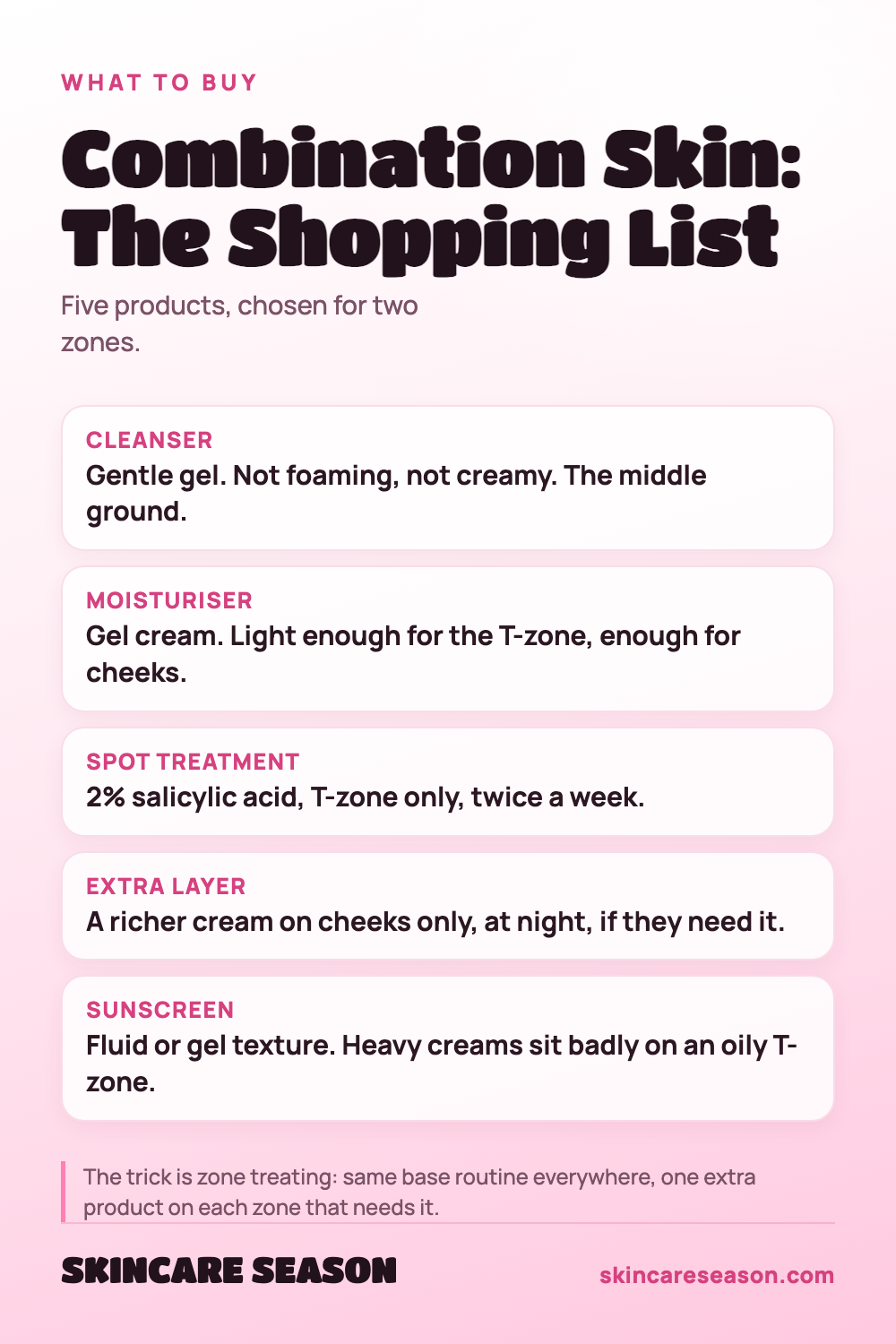
Five products, and only two of them are zone-specific. The base routine is the same everywhere, and you add one thing where each zone needs it.
 Save
Cleanser: the middle ground
A gentle gel cleanser. Not a foaming one, which will strip your cheeks. Not a cream or balm cleanser, which tends to leave a film your T-zone does not want.
Gel sits between the two and is the one category where a compromise genuinely works.
Once a day, at night. Water in the morning is enough for most combination skin, and morning cleansing is a common cause of cheeks that are drier than they need to be.
Moisturiser: gel cream
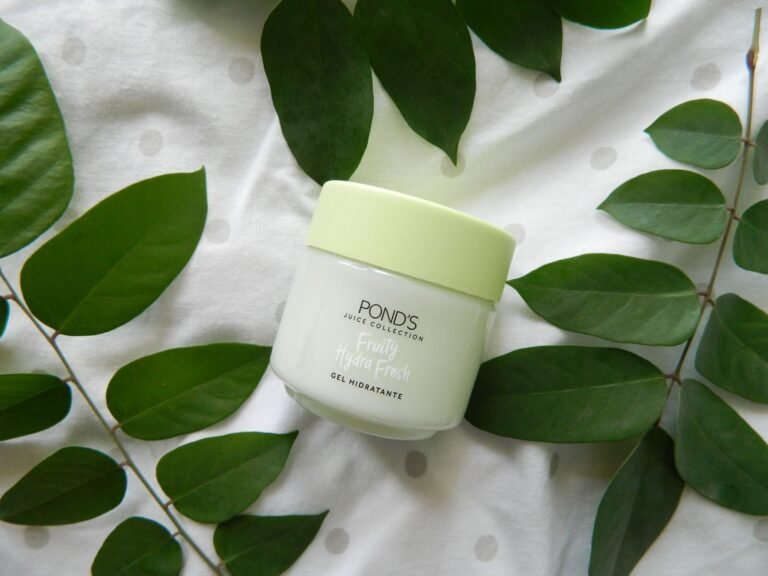
This is the product to get right, and gel cream is the texture that solves it.
A gel cream is lighter than a cream and more substantial than a gel. It absorbs without leaving a heavy film, which suits the T-zone, while containing enough humectant and emollient to keep cheeks comfortable.
Look for glycerin and hyaluronic acid high in the list, with a light emollient rather than heavy butters. Niacinamide in the formula is a bonus, since it helps regulate oil.
Apply more of it to your cheeks and less to your T-zone. That is the whole of zone treating in one sentence.
Watch this before you start
The T-zone extra
A 2% salicylic acid product, twice a week, on the forehead, nose and chin only.
Salicylic is oil-soluble, so it gets inside the pore and clears the congestion that oily zones accumulate. On your cheeks it would be drying with nothing to gain, which is exactly why this is a zone product.
Applied after cleansing, before moisturiser, on dry skin, and only where you actually get congestion.
 Save
The cheek extra
If your cheeks are still tight after the gel cream, add a richer cream on top of it, at night, on the cheeks only.
Not instead of the gel cream. On top. The gel cream hydrates, the richer layer seals, and you are only sealing where sealing is wanted.
A squalane or rosehip oil works the same way if you would rather have one bottle than two creams. Two or three drops, pressed into the cheeks over the moisturiser.
Sunscreen: texture is everything
The most common complaint about combination skin and sunscreen is that everything feels greasy on the T-zone.
Look for fluid, gel or watery-textured formulas. Korean and Japanese sunscreens are generally excellent here and have spent longer solving that specific problem than western brands have.
Avoid heavy cream sunscreens and anything described as ultra-hydrating, which will sit on an oily forehead and slide.
What not to buy
- Mattifying primers as skincare. They control shine cosmetically and do nothing for the underlying skin.
- Clay masks on the whole face. T-zone only, if at all. On cheeks they are simply drying.
- Alcohol-heavy toners. They degrease the T-zone temporarily and provoke it to produce more.
- Two entirely separate routines. Overkill, expensive, and nobody keeps it up.
FYI the mattifying products are the biggest money trap in this category. They make skin look less shiny for a few hours and change nothing. :/
 Save
Seasonal drift
Combination skin shifts more than most through the year, and the balance is worth revisiting twice.
In summer the T-zone gets oilier and the cheeks often behave themselves, so the gel cream may be enough everywhere. In winter the cheeks get drier while the T-zone stays oily, so the cheek extra becomes necessary.
You do not need a new set of products. You need to adjust how much of each you use, and where.
How to tell if you actually have combination skin
Worth checking, because a lot of people who think they have combination skin have dehydrated oily skin, which needs a different answer.
The test takes a morning. Cleanse at night, apply nothing at all, and look at your face when you wake up.
If your T-zone is shiny and your cheeks feel comfortable, you are oily rather than combination. If your T-zone is shiny and your cheeks feel tight or look flaky, that is combination.
If everything feels tight including the T-zone, and it still gets shiny by midday, that is dehydrated oily skin. The answer there is more hydration everywhere and fewer stripping products, rather than zone treating.
Common questions
Should I use two different moisturisers?
One gel cream everywhere, plus a richer layer on the cheeks at night if needed. Not two full routines.
Is a mattifying moisturiser a good idea?
Not usually. They tend to be drying, and on combination skin you would be drying your cheeks to help your forehead.
Can I use a clay mask?
On the T-zone only, once a week at most. Not across the whole face.
Do I need to cleanse in the morning?
Usually not. Water is enough, and it keeps the cheeks happier.
What is the single most useful product?
A good gel cream. It is the one that has to work for both zones.
Does combination skin change with age?
Often yes. Oil production tends to fall over time, and many people become steadily drier and less combination through their thirties and forties.
The short version
Gel cleanser at night, gel cream everywhere with more on the cheeks, salicylic acid on the T-zone twice a week, a richer layer on cheeks at night if needed, and a fluid sunscreen.
Same base routine, one addition per zone. That is all zone treating is. 🙂



Leave a Reply