

Peptides are on the front of an enormous number of expensive bottles, and almost nobody selling them explains what they are. The word does a lot of work precisely because it sounds technical and means very little on its own.
It is also not one ingredient. It is a category covering several unrelated jobs, which is why two peptide serums can do completely different things and both be honestly labelled.
Here is what is actually in the category.
 Save
What a peptide is
A peptide is a short chain of amino acids. Amino acids are what proteins are built from, and collagen is a protein.
So a peptide is a fragment of the same material your skin uses for structure. The theory behind putting them on your face is that certain fragments act as messengers: your skin reads them as a signal that collagen has broken down, and responds by making more.
That is a real mechanism. The honest caveat is that it is a modest effect over a long period, not a dramatic one.
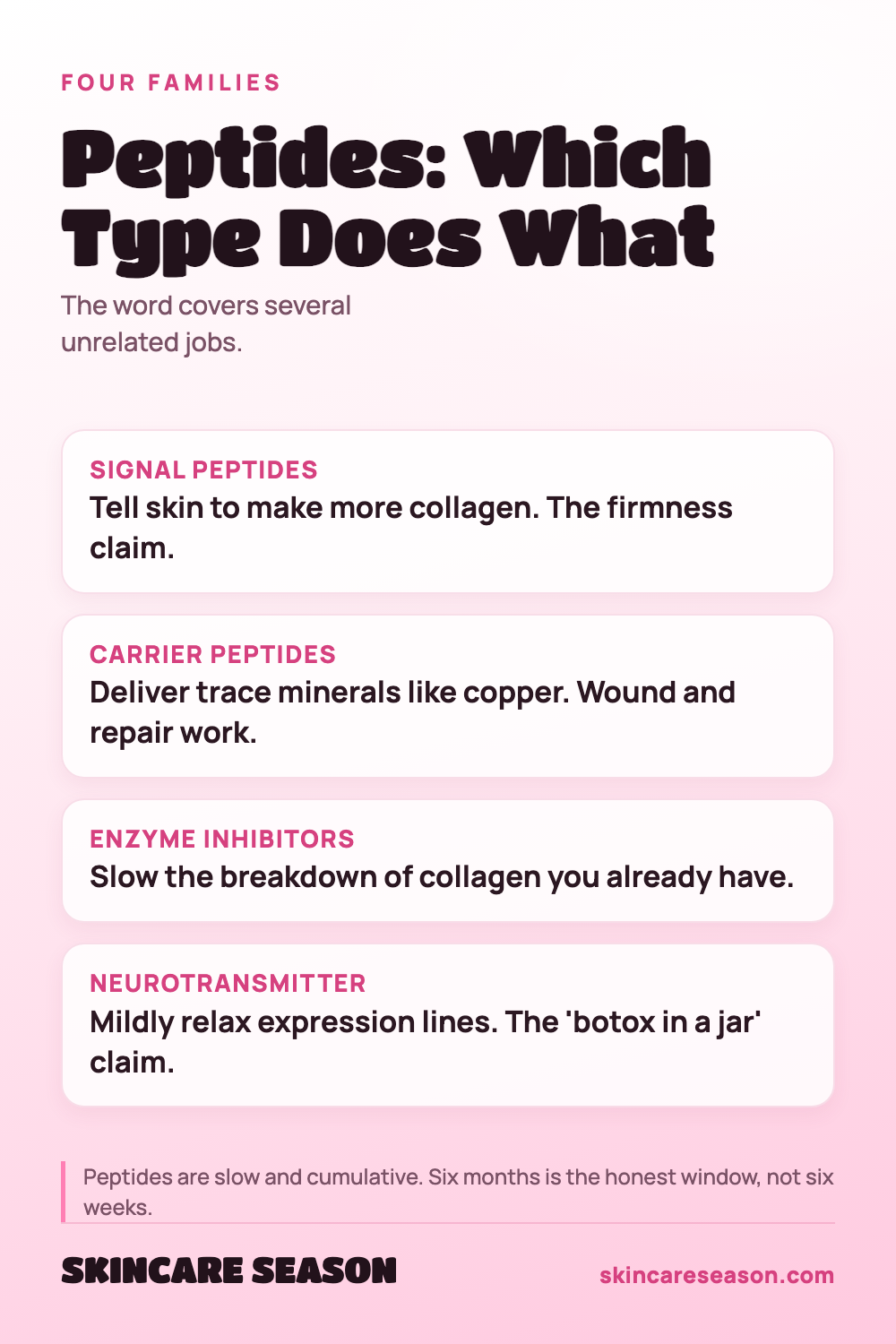
The four families
 Save
These do genuinely different things, which is why “does it contain peptides” is the wrong question. Which peptide, and for what, is the right one.
 Save
Signal peptides, the firmness claim
The largest group and the one most products mean. Palmitoyl pentapeptide and palmitoyl tripeptide are the common names to look for.
The evidence here is reasonable but modest. Studies tend to show measurable improvements in firmness and fine lines over three to six months, at magnitudes noticeably smaller than retinoids produce over the same period.
Which is the honest framing: peptides are a supporting act to a retinoid, not a replacement for one. Anyone selling them as a gentler alternative that works just as well is overstating it.
Neurotransmitter peptides, the botox claim
Argireline is the famous one, and it is the source of the “botox in a jar” line that has followed this category for twenty years.
It works, slightly, on expression lines by mildly interfering with the signal that makes small facial muscles contract. The effect is real, temporary, and considerably smaller than the comparison implies. Nobody has ever mistaken it for an injectable.
IMO it is worth having in a formula and never worth paying a premium for on its own. :/
 Save
Copper peptides, the difficult one
Copper peptides have the most enthusiastic following and the most complicated practical advice.
They are carrier peptides, delivering copper into the skin where it is involved in repair and collagen synthesis. The research is genuinely interesting, and there is a real case for them.
The complication is that copper peptides do not play well with several things people already use. Direct vitamin C is the main one, and strong acids are the other. If you use copper peptides, they want their own step, ideally their own time of day.
What peptides will not do
They will not work quickly. Six months is the honest evaluation window and three is the minimum. If you are judging at week four you will conclude they do nothing, and at week four they have done nothing.
They will not exfoliate, they will not fade pigmentation meaningfully, and they will not clear congestion. Those are other ingredients.
And a peptide in a rinse-off cleanser is decorative. It needs to stay on your skin to do anything, so peptide face washes are marketing rather than formulation.
 Save
How to use them
- Leave-on products only. Serum or moisturiser, never a cleanser.
- Morning or night, both fine. Copper peptides prefer their own slot.
- Consistently, because the entire effect is cumulative.
- Alongside a retinoid, not instead of one, if firmness is the goal.
- Keep copper peptides away from direct vitamin C and strong acids in the same routine.
They are among the most tolerable actives there are, which is their genuine advantage. If your skin cannot handle retinoids or acids, a peptide serum is something you can almost certainly use every day without incident.
Is it worth the money
Sometimes. Peptides are genuinely expensive raw materials, so unlike some ingredients the price is not purely brand markup.
The problem is that plenty of products list a peptide at a concentration far too low to do anything, purely so the word can go on the front. FYI a peptide appearing after the fragrance and preservatives on an ingredient list is decoration.
Buy peptides if you already have the basics in place: sunscreen daily, a retinoid if you tolerate one, a decent moisturiser. As the fourth thing you add, they are reasonable. As the first, they are a waste of a budget that should have gone on sunscreen.
Watch this before you start
Where peptides sit in a routine
Peptides are water-soluble and usually formulated into light serums, so they go on early, after cleansing and before anything heavier.
A simple version that works: cleanse, peptide serum, moisturiser, sunscreen in the morning. At night, cleanse, retinoid, then peptide serum or a peptide moisturiser over the top.
The one arrangement to avoid is layering copper peptides directly under or over a vitamin C serum. Split them by time of day and the problem disappears entirely.
Common questions
How long before peptides do anything?
Three months minimum, six for a fair assessment. This is the slowest common ingredient.
Are peptides better than retinol?
No, but they are far gentler. Retinol has stronger evidence for firmness and texture. Peptides suit people who cannot tolerate it.
Can I use peptides with vitamin C?
Most peptides, yes. Copper peptides specifically, keep them in a separate routine.
Do peptide creams work as well as serums?
Either works, as long as it stays on the skin. The format matters less than the concentration and consistency.
Is collagen in a cream the same thing?
No. Whole collagen molecules are far too large to penetrate and sit on the surface as a moisturiser. Peptides are fragments small enough to matter.
The short version
Peptides are short amino acid chains that signal your skin to repair and rebuild. The effect is real, modest, and slow, and the category covers four quite different jobs.
Worth adding once sunscreen, moisturiser and a retinoid are already in place. Not worth buying instead of any of those, and not worth judging before month three. 🙂


Leave a Reply