


This is the bottle people buy when they are told their skin needs hydration, and it is also the bottle that generates the most confused complaints. Half the people who use it say their skin feels softer. The other half say it made them tighter and flakier than before.
Both groups are telling the truth. The difference between them is one step, and it takes four seconds.
Here is what this serum is, who it suits, and the rule that decides which camp you end up in.
 Save
What is actually in the bottle
A blend of hyaluronic acid at several different molecular weights, plus vitamin B5, in a water base. That is essentially the whole formula.
The different weights matter more than the percentage. Larger molecules sit on the surface and hold water there. Smaller ones travel a little deeper into the upper layers. Using a range means you get hydration at more than one level rather than a film sitting on top.
Hyaluronic acid is a humectant. It does not moisturise in the way a cream does. It attracts and holds water, which is a different job and comes with a catch.
The catch that ruins it for people
A humectant pulls water toward itself from wherever water is available. If your skin is damp and you seal it in, it pulls from the moisture you just applied and holds it there. That is the soft, plump result.
If your skin is bone dry, the air is dry, and you put nothing on top, it has only one water source available: the deeper layers of your own skin. So it pulls water up and out, where it evaporates.
That is why people report it drying them out. The product worked exactly as designed, in the wrong conditions. :/
Watch this before you start
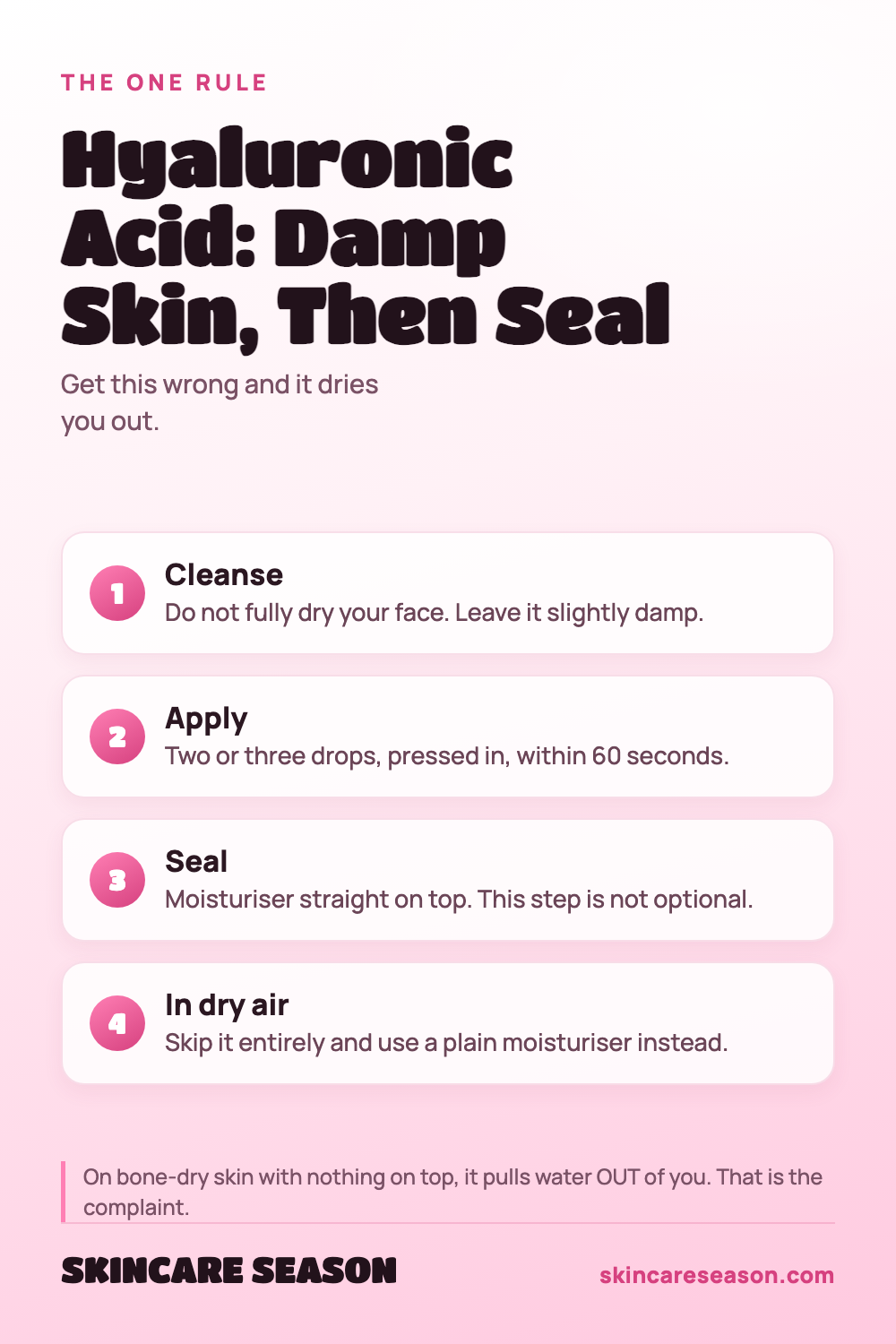
The rule that fixes it
 Save
Damp skin, then seal. Those four words are the entire review. Get them right and this is a genuinely good serum for the money. Get them wrong and it actively works against you.
 Save
How to apply it properly
Cleanse and pat your face rather than drying it. You want it visibly damp, not dripping.
Two or three drops, pressed in rather than rubbed, within about a minute of cleansing. Any longer and your skin has already dried.
Then moisturiser straight on top, immediately. This is the step people skip, and it is the one doing the work. Without something occlusive over it, the water you just trapped simply leaves.
- Damp skin, not dry. The single biggest factor.
- Within 60 seconds of cleansing.
- Moisturiser on top, always, no exceptions.
- Two or three drops. More does not hold more water.
When to skip it entirely
In a cold, dry winter with the heating on, or in a genuinely arid climate, a humectant with nothing to draw on is fighting your skin.
In those conditions, a plain ceramide moisturiser will do more for you than this serum will, and you can go back to it when the air changes. FYI this is why people find it brilliant in summer and useless in January, and assume the formula changed.
 Save
Who it genuinely suits
Oily and combination skin get the most from it, because it adds hydration without adding oil, and those skin types often skip moisturiser and then wonder why they are shiny and tight at once.
It also suits anyone using retinol or acids, where the barrier needs help holding water and a heavy cream feels like too much on its own.
It suits dry skin least, which is the opposite of what most people assume when they buy it. Dry skin is short of oil as well as water, and a humectant does nothing about the oil half.
What it will not do
It will not plump out fine lines in any lasting way. There is a temporary smoothing effect from hydration, which is real and disappears when the hydration does.
It will not fix dryness on its own, it will not do anything for tone or pigmentation, and it is not comparable to an injectable, despite sharing a name.
 Save
Is it worth the money
At this price, yes, with an asterisk. It is a competent multi-weight hyaluronic serum for the cost of a coffee, and there is no meaningful reason to pay ten times more for the same ingredient.
The asterisk is that hyaluronic acid is one of the most commonly included ingredients in skincare, and there is a fair chance your moisturiser already contains it. IMO if you already use a decent moisturiser and your skin is happy, this is a solution looking for a problem.
Buy it if your skin is oily, dehydrated, and you are already using a moisturiser you like. Skip it if you are dry, or if you were hoping it would replace a cream.
How it compares to a plain moisturiser
This is the comparison worth making, because for a lot of people the honest answer is that they need one or the other rather than both.
A moisturiser typically does three jobs at once. It humectants, it softens, and it seals. A hyaluronic serum only does the first of those, which is why it depends so completely on what goes over it.
So if you own one product, own a moisturiser. If you own two and your skin is oily or dehydrated, this is a sensible second. If your skin is dry, the second product should be an oil or a richer cream, not this.
Common questions
Why does my skin feel tight after using it?
You applied it to dry skin, or you did not seal it with a moisturiser. Fix either and the problem usually disappears.
Can I use it morning and night?
Yes, and it plays well with everything. Just keep the damp-then-seal rule both times.
Does it pill?
It can, if you use too much or layer it under a heavy cream too quickly. Fewer drops, and let it absorb for thirty seconds.
Should I use it with niacinamide?
Yes, they pair well. Niacinamide first, then this, then moisturiser.
Is a higher percentage better?
No. Above a low percentage, more hyaluronic acid makes the serum tackier without holding more water. The molecular weight range matters more than the number.
The short version
A cheap, perfectly good multi-weight hyaluronic serum that only works if you apply it to damp skin and put a moisturiser on top. In dry air, skip it and use a proper cream instead.
Nearly every bad review of this product is a description of those four seconds being skipped. 🙂

Leave a Reply